
Libreville-Bata Corridor: Inauguration of Akurenam-Kogo Section Reshapes Logistics in Central Africa
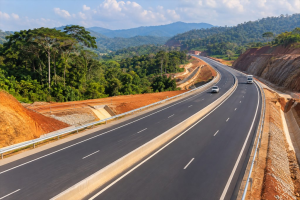
Central Africa is accelerating the modernization of its cross-border transport axes. On September 27, 2026, Equatorial Guinea inaugurated the Akurenam-Kogo road section (116 km), marking a decisive step in unlocking border areas and interconnecting regional logistics networks. Financed with 198 billion FCFA and executed by China Road, this infrastructure constitutes a vital link in the Libreville-Bata corridor.
Beyond its immediate impact on internal Equatorial Guinean transit, this project directly reinforces the physical backbone of cross-border trade within the CEMAC zone. As the implementation of the African Continental Free Trade Area (AfCFTA) demands the swift reduction of both physical and non-tariff barriers, building a high-performing multimodal corridor connecting Gabon, Equatorial Guinea, and Cameroon becomes essential for regional attractiveness and logistics competitiveness.
A 198 Billion FCFA Investment at the Heart of CEMAC Priority Projects
A Strategic Asset Connecting the Hinterland to Maritime Facades
The completion of the Akurenam-Kogo section provides continuous road connectivity between the interior Centro Sur region of Equatorial Guinea and the country’s southwestern coastline. This highway development aligns with the strategic infrastructure priorities of the Economic and Monetary Community of Central Africa (CEMAC).

“Building new roads alone is not enough to generate more trade. Their economic return will depend on their effective connection to markets, logistics platforms, and neighboring countries’ transport networks.”
— World Bank
By opening a modern overland route toward Kogo, Equatorial Guinean authorities are establishing the foundations for a secondary logistics node capable of streamlining the movement of manufactured goods and agricultural products between southern Equatorial Guinea and northwestern Gabon.
The Gabonese Link: The Kougouleu-Medouneu-Akurenam Project
The full operational efficiency of this cross-border corridor now depends on progress on the Gabonese side. The planned construction of the 168-kilometer Kougouleu-Medouneu-Akurenam section represents the missing link required to achieve a direct overland connection between Gabon’s Estuaire province and the Equatorial Guinean highway network.
Once completed, this continuous multimodal route will significantly eliminate the infrastructure fragmentation that historically hampered road freight between Libreville and Bata.
Impact on Shippers and Regional Logistics Competitiveness
Reduced Transit Times and Lower Fleet Operating Costs
For shippers and road hauliers, the commissioning of the Akurenam-Kogo stretch substantially alters logistics cost structures across the regional network:
-
Shorter Travel Times: Full paving across the 116 km eliminates seasonal bottlenecking caused by degraded unpaved tracks.
-
Lower Vehicle Maintenance & Idle Costs: Reduced fleet downtime and minimized mechanical wear and tear on heavy goods vehicles (HGVs).
-
Enhanced Supply Chain Predictability: Smoother scheduling for distributors and manufacturers operating between Southern Cameroon, Malabo, Bata, and Libreville.
Maritime-Land Synergy: The Emergence of the Kogo Logistics Hub
The road connection gains further strategic relevance when viewed alongside complementary infrastructure plans in Equatorial Guinea. The proposed development of a Special Economic Zone (SEZ) and a dry port near Kogo aims to establish a modern cargo handling and transshipment hub.
This facility will process freight coming from the ports of Owendo (Gabon), Bata (Equatorial Guinea), and Kribi (Cameroon), while providing value-added services (bonded warehousing, deconsolidation, light processing) to supply the regional market.
Why This Matters for African Corridors
Eliminating Customs Enclaves: The Libreville-Bata corridor framework supports the harmonization of cross-border transit procedures throughout the CEMAC zone.
Coastal & Overland Synergy: Linking seaports with hinterland road networks provides a viable alternative to purely maritime cabotage along the Atlantic coast.
Accelerating AfCFTA Goals: Seamless cross-border road continuity acts as a direct catalyst for boosting intra-African trade volumes and regional industrial integration.
Trade Facilitation Challenges and Investment Outlook in Central Africa
While physical infrastructure is essential, economic analysis confirms that the return on the 198 billion FCFA investment hinges on resolving non-tariff barriers. Streamlining border inspections, digitizing transit documentation, and establishing joint border posts remain critical to achieving tangible reductions in overall freight costs.
For institutional investors and private logistics operators, the development of the Libreville-Bata corridor presents targeted opportunities:
-
Warehousing & Cold Chain Infrastructure: Developing temperature-controlled and secure storage facilities along the Kogo-Akurenam route.
-
Multimodal Transport Operations: Structuring modern freight trucking fleets compliant with international safety and environmental standards.
-
Trade Facilitation & Financial Services: Single-bond guarantee schemes and digital cross-border payment solutions.
The Akurenam-Kogo link demonstrates the political commitment of CEMAC member states to accelerate key Central African corridors—an indispensable prerequisite for turning AfCFTA objectives into real commercial volumes.